

This post contains affiliate links. I will earn a small commission, at no extra cost to you, if you make a purchase through these links.
Philodendron Micans is one of those plants you’ve probably seen popping up on your Instagram feed more and more each day, and for good reason!
In this post, I’ll review Philodendron Micans care and propagation, and by the end, you’ll know exactly why this plant should be next on your list!
Foliage
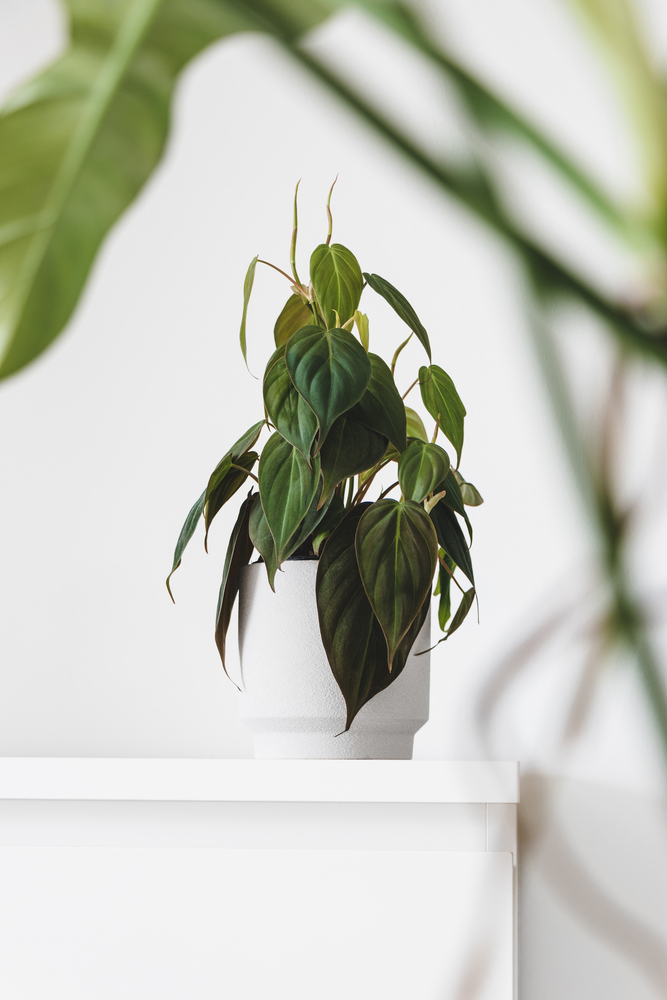
Also known as the velvet leaf philodendron, the Micans is known for its “velvet” leaves that almost appear to be iridescent, ranging from shimmery shades of emerald green to turquoise to bronze in the right light.
Is Philodendron Micans fast growing?
Similar to the Heartleaf Philodendron and other climbing vines, the Philodendron Micans is a fast grower and in optimal conditions can grow several feet in a year.
Where Can I Buy a Philodendron Micans?
You can easily find Philodendron Micans cuttings and plants on Etsy. Check out this stunning Micans (available in a pot or hanging basket) from one of my favorite Etsy shops!
How Do You Care for a Philodendron Micans?
The basic care requirements are:
- Provide with bright, indirect light
- Water when the top inch or two of the potting mix is dry
- Use a well-draining potting mix
Read on for a full care and propagation guide!
How much light does a Philodendron Micans need?
Bright, indirect light is best. Don’t place it in direct light—too much can burn the leaves. While it can survive in low light it won’t grow as full or nearly as fast.
If you don’t have much natural light in your home, guess what—you can still grow a beautiful Philodendron Micans! Grow lights are a lifesaver for low-light homes.
These grow lights are my absolute favorite! And my plants are loving them too which is what really matters! My little Micans plant has been pushing out new growth like crazy under these lights.

How Often Do You Water a Philodendron Micans?
Water your plant when the top inch or two of the potting mix is dry.
How often that is will depend on factors that help dry out the potting mix, like light level. However, every week to 10 days is a good rule of thumb.
Try not to overwater your plant. Doing this consistently could put it at risk of root rot. To help avoid this, get into the habit of sticking your finger down into the potting mix to feel for moisture before watering your plant.
Do Philodendron Micans like to be misted?
Philodendron Micans is native to tropical regions—Dominica and Tobago—so they do like humidity. While you can mist your plants, I personally don’t find misting to be an effective method of providing humidity
I prefer to use a humidifier. Why? It’s easy, low-maintenance, and can help many plants at once. I really love this humidifier because it can last up to 96 hours…that’s four days without having to refill it!
For step-by-step guides and more easy methods, check out my post on creating humidity for houseplants.
Want this absolutely stunning foliage in your home? Grab a Micans here!
Temperature
Native to warm regions, the Micans of course prefers warm temperatures! Don’t worry, though. It will do just fine in normal household temperatures.
Just try not to let it get below 60 degrees Fahrenheit (around 16 degrees Celcius). Move it away from drafty areas or cold windowsills in the winter.
Potting Mix
Philodendron Micans is low maintenance when it comes to potting mix. All it needs is a well-draining indoor plant mix. If I have it on hand, I always like to add in a few handfuls of perlite for even better drainage.
Fertilizing
As a fast grower, this plant doesn’t really need fertilizer, but fertilizing now and then can help it thrive to its full potential.
You can use an indoor plant fertilizer once a month during the growing season (spring and summer) to feed this plant.
Repotting
Repot your Philodendron Micans when it becomes rootbound. Depending on how fast your plant is growing this might be every year to every few years.
Signs of a rootbound plant include roots coming out of the drainage holes, stunted growth, a general sorry-looking plant, and if you remove the plant a little from the pot and see that the roots are heavily coiled around the outside of the soil.
Repot this plant in late winter or early spring in a pot the next size up from the current pot that has good drainage.
I really love terra cotta pots because they dry out quicker putting your plant at less risk of root rot!
Climbing and Support
In its natural environment, Philodendron Micans climbs using aerial roots. Aerial roots also help absorb nutrients, so putting them to use will only benefit your plant.
Alowing your Micans to climb by giving it some form of support will help your plant to grow strong and healthy.
Here is the stackable moss pole I use for all my climbing plants. It’s so convenient to be able to add more to the top when your plant outgrows the current height of the pole!
As part of your watering routine, mist your moss pole so your Philodendron Micans’ aerial roots can get a nice drink, too.
Pruning
Pruning is not always required but is handy to control the size and shape of the plant.
Philodendron Micans and other vining plants can get “leggy” which is when the vines become very long and stretched out with fewer leaves. Often, it’s due to the plant trying to reach out to find more light.
You can remove leggy vines and create a more bushy plant by pruning the vines to encourage new growth. When pruning, use sterilized pruning shears to cut about a 1/4 inch above a node.
In addition to correcting leggy growth, prune off any occasional yellow, dying leaves once they can be gently plucked away from the plant.
How do you make Micans bushy?
Here is a more in-depth explanation of how to make your Micans bushy by pruning it:
New growth will come out of the nodes, so choose a spot where you want more growth, and cut ABOVE that node (where the leaf meets the stem).
“Above” a node refers to if you hold the vine pointed towards the ceiling, you’re cutting above it. So the node will stay on the main plant. New growth will grow out of that node on the plant.
You can also stick the cuttings right back into the pot. They will root there and make for a bushier plant. Last, make sure your plant is getting plenty of bright, indirect light which will help keep it nice and full!
The photo below shows a node I’ve circled on my Micans. Sorry if it’s a little dark—I did my best!
See how there’s a new leaf growing out of that node? That’s why you cut above a node when you want to encourage new growth.
There are also some tiny aerial roots on the node!
Pests and Other Problems
A few common houseplant problems, which Philodendron Micans is no exception to, include:
Leggy Vines
Legginess tends to happen with vining plants. It’s not something big worry about, but it can be visually unpleasing. It happens when the plant isn’t getting enough light.
The vines grow long and stretched out with fewer leaves. The plant is trying to “reach out” for more light and also conserve energy. Make sure your Micans is getting bright, indirect light!
Pests
Some common pests include fungus gnats, mealybugs, scale, aphids, and spider mites.
Check regularly underneath leaves and in crevices for pests. I really like this insecticidal soap for help with pest control, which works on a range of pests.
Always read the instructions on the label first and use caution if you have pets.
Yellow Leaves
This can be caused by too little light or too much light, too much or too little water, or a nutrient deficiency.
Start by evaluating your plant’s light situation. Then, stick your finger in the potting mix to determine moisture level and evaluate your watering routine. Last, evaluate your fertilizer regimen.
Brown/Crispy Leaves
This can be caused by too much direct light, too much or too little water, too little humidity, or too much fertilizer.
Start by evaluating your plant’s light situation—move it out of direct light if needed. Then, stick your finger in the potting mix to determine moisture level and evaluate your watering routine.
Next, provide your Philodendron Micans with some humidity if you are not already doing so. Last, evaluate your fertilizer regimen.
Convinced this is the plant for you? You can buy a Philodendron Micans here!
How Do You Propagate a Philodendron Micans?
How to Propagate Philodendron Micans in Water
Just like other vining plants, Micans can be propagated easily in water.
- Use a pair of clean scissors to cut about a 1/4 inch below a node on a piece of vine that has a few leaves. You need to include the node on the cutting because that’s where new roots will sprout from.
- Place the cutting in a jar of room-temperature water, making sure at least one node is under the surface. If any leaves are sitting under the water’s surface, gently remove them from the stem.
- Place the cutting in a location with bright, indirect light. Top off the water when it gets lower and change the water when it gets murky or slimy, about every few days to a week.
- Roots will start to sprout from the nodes within a few days, but it will be a few weeks before you can transfer your cutting into potting mix.
- Wait until the roots are two to three inches long. Then, transfer the cutting to its permanent pot, give it a good watering, and care for it like you normally would with this plant.
They can also be left in water permanently, but they won’t grow as large or as fast.
How to Propagate Philodendron Micans in Soil
Method One
Propagating Philodendron Micans in soil follows the same general method as water propagation.
- Use a clean pair of scissors to cut about a 1/4 inch below a node on a piece of vine that has a few leaves. You need to include the node on the cutting because that’s where new roots will sprout from.
- Instead of putting the cutting in a jar of water, plant it directly into an appropriately sized pot with moistened potting mix. Make sure at least one node is underneath the potting mix because that’s where the roots will sprout from, and don’t bury any of the leaves.
- Place the cutting in a location with bright, indirect light and keep the potting mix moist, but not wet.
- You can also place a clear plastic bag over the top to help lock in humidity, but open it every few days to let in fresh air.
- It will be a few weeks before a new root system is established and before you’ll notice significant new growth on the cutting.
- After a few weeks, you can also test your plant by giving it a very gentle tug. If there is resistance, a root system has developed and you can treat it like a normal plant.
Method Two
- Another method that is easy to do with vining plants like Philodendron Micans is to place the entire cutting down so it’s all laying on top of the surface of the potting mix, with all the nodes on the vine facing down into the mix.
- If needed, temporarily “fasten” the vine to the mix using bobby pins or paper clips. Keep the mix moist, but not wet, and place it in bright, indirect light.
- You can also place a clear plastic bag over the top to help lock in humidity, but open it every few days to let in fresh air.
- The nodes will eventually take root this way, too!
Is Philodendron Micans Toxic to Animals?
Yes, Philodendron Micans is toxic to cats and dogs, so be sure to keep this plant out of your furry friends’ reach!
How do you get big leaves on Micans?
Ultimately, the way to get big leaves on your Micans is to keep your plant healthy by caring for it properly! You won’t get big leaves without proper lighting, so be sure to give it lots of bright, indirect light.
Also, since this plant climbs naturally, giving it a moss pole to climb will help it grow bigger and stronger.
Are Philodendron Micans Rare?
Philodendron Micans used to be rare, but within the past few years, it has become easier to get your hands on. Before that, you may have only gotten one by having a friend who could give you a cutting.
Luckily, you can now find them easily online, right here!
Philodendron Micans Care Summary
- Provide with bright, indirect light
- Water when the top inch or two of the potting mix is dry
- Provide with humidity and warm temperatures
- Use a well-draining potting mix
- Fertilize once a month during the growing season
- Repot when rootbound
More Philodendron Posts
- Philodendron Melanochrysum
- Philodendron Florida Ghost
- Philodendron Verrucosum
- Pink Princess Philodendron
- Philodendron Gloriosum
- Heartleaf Philodendron
- Philodendron Brasil
- Philodendron Birkin
Ray Abraham says
Thank you Julie. I LOVE my Micans!!!
Jayne says
I’m looking for tips on using a grow light with my philodendrons. Curious about distance from the plant, and length of time. I have newer windows that I don’t think let in the correct type of light.